


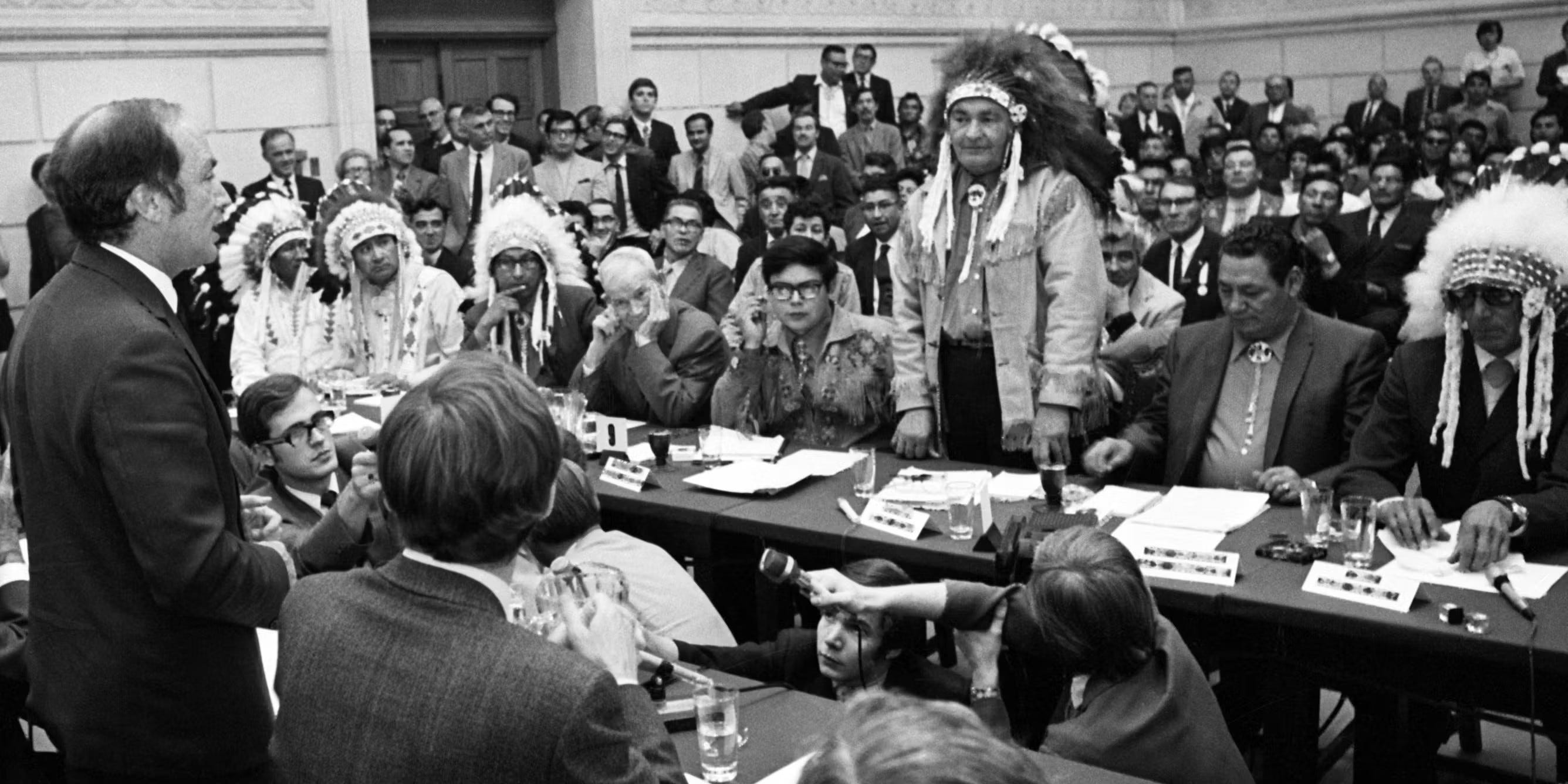
In 1969 Pierre Trudeau’s government released a White Paper on Indian Policy. It proposed to abolish Indian status, dismantle the Indian Act, and fold Indigenous peoples into Canadian citizenship as formal equals under the law. The intention, stated plainly, was assimilation, though the word was avoided. Come inside the institutions. Become Canadians like everyone else. The distinctions that have caused so much difficulty will simply cease to exist.
Indigenous leaders rejected it immediately and forcefully. Harold Cardinal’s response, Citizens Plus, became the founding document of the modern Indigenous rights movement in Canada. The rejection was understandable. The White Paper offered to dismantle the existing framework, racist and paternalistic as it was, without replacing it with anything structurally equivalent or better. It was subtraction without addition. Take away the Indian Act, which for all its failures at least acknowledged a distinct legal relationship and set of rights, and offer in exchange formal equality with no material or political mechanism behind it.
That is not a deal. That is a dispossession dressed in liberal language.
But something important happened in the wake of that rejection that has never been examined honestly. The doctrine that hardened out of it, that Indigenous peoples must remain structurally outside provincial and federal institutions to preserve their sovereignty, has served the progressive political class better than it has served the communities it claimed to protect. Fifty-six years later, First Nations life expectancy in BC has fallen to 67.2 years against 82 for non-Indigenous residents. Forty percent of BC’s homeless population is Indigenous despite being six percent of the census population. The clean water advisories, the income gaps, the incarceration rates: none of it has improved in any meaningful way through fifty years of consultation, conference, and aspirational legislation.
The doctrine that kept Indigenous peoples outside the institutions did not preserve their sovereignty. It preserved the professional class built around the permanent negotiating position. Those are not the same thing.
Here is what the White Paper should have been.
Not the elimination of distinct legal status without replacement. Not assimilation dressed as equality. A genuine exchange: the dismantling of the racist architecture of the Indian Act in return for guaranteed seats at the table where decisions about Indigenous lives are actually made. Representation proportional to population. Selection of representatives determined entirely by the nations themselves. Historical grievances handled by a dedicated tribunal with real authority to settle them with finality. Forward governance handled by the legislature with Indigenous voices guaranteed inside it.


That offer was never made. It needed to be made then. It needs to be made now.
The template existed in 1969. It had existed since 1867. New Zealand had created Māori seats in its parliament that year, four dedicated seats for Māori representation in a Westminster parliamentary system culturally and legally similar to Canada’s. The Waitangi Tribunal would follow in 1975, six years after Trudeau’s White Paper, providing exactly the dedicated mechanism for settling historical grievances that Canada chose not to build. New Zealand took the fork in the road that Canada saw and drove past.
One hundred and fifty-seven years later the Māori seats still exist. The Waitangi Tribunal still operates. Māori political identity is stronger, not weaker, for having representation inside the institutions. The Māori Party operates as a distinctly Māori political institution within the Westminster system. It has not been absorbed into the two-party structure. It has used parliamentary presence to advance Māori interests including treaty settlements and language revitalization. Presence expanded sovereignty rather than diminishing it.
What is worth knowing is that the Māori seats were not introduced as a permanent fixture. They were introduced in 1867 as a temporary measure, intended to last five years while the political situation settled. They became permanent because they worked. Because the people they were designed to serve found them worth keeping. Because presence inside the institution produced results that absence never had.
That history is directly relevant to what BC should do now and how it should do it.
Trust between Indigenous and non-Indigenous British Columbians has been eroded by decades of broken promises, failed legislation, and political theatre performed in place of structural change. Introducing designated seats as a two or three term provisional measure, subject to honest assessment of whether they are genuinely serving the communities they were designed to serve, is not a concession to that distrust. It is an honest acknowledgment of it. It says we are not asking you to trust us. We are asking you to try this with us and tell us plainly whether it is working. If it works, it stays. If it needs adjustment, we adjust. If the communities it serves decide it has failed them, the conversation continues from a position of actual experience rather than theoretical debate.
This is how serious structural change survives political transition. Not by being imposed permanently from the outset and defended against every objection, but by being introduced humbly, assessed honestly, and made permanent by the demonstrated will of the people it serves. New Zealand did not design its Māori seats to last forever. They lasted forever because they earned it.
The instinctive response to this comparison is to reach for the assimilation objection. Entering Westminster institutions means accepting their authority. Representation becomes absorption. The colonizer’s framework doesn’t change and Indigenous peoples are simply invited inside on terms the colonizer sets.
This objection deserves a direct answer rather than a dismissal because it contains real historical grounding. Every previous attempt to bring Indigenous peoples into Canadian institutions has carried embedded assumptions about how that participation would look, what form it would take, what legitimacy structure would underpin it. That is where the colonial imposition actually lives, not necessarily in the institution itself but in the insistence that participation conform to the dominant culture’s procedural norms.
The proposal under discussion is different in a way that matters fundamentally.
The seats exist. How they are filled is entirely the nations’ business.
That sentence does more work than it appears to. It separates the question of access from the question of governance. The legislature provides the room. The nations decide who sits in it, on what basis, according to what internal process their own traditions and governance structures determine. A Westminster institution provides the forum. Indigenous governance provides the representatives. Those are two entirely different things operating simultaneously without either subordinating the other.
It goes further. In its most developed form the seats need not be filled by a single fixed representative. They could rotate based on the issue being debated. If a piece of legislation impacts one nation more directly than others the seats could be filled by representatives from that nation. If the matter is provincial in scope the representatives could come from a broader body the nations themselves constitute for exactly that purpose. The only requirements are that the seats be filled, that they be used, and that the Indigenous population of BC is satisfied with the representation it is receiving. The nations still retain the right to vote in whatever riding they live in, their residential political participation unchanged, their national political voice finally guaranteed.
Some will call this double representation. It is not. It is the recognition that Indigenous political identity is not primarily geographic in the settler sense. It is national, historical, and relational in ways that a riding vote simply cannot capture. What the proposal addresses is not double representation but double subjugation without representation: the condition of being governed by institutions you have no guaranteed voice in while your own governance structures operate in parallel without institutional leverage over the decisions that most affect your communities.
The decisions don’t stop because Indigenous peoples aren’t in the room. The BC Legislature legislates regardless. Budgets that determine housing, health, and clean water on reserves are set regardless. The question has never been whether Westminster institutions will govern Indigenous lives. They do and they will and this will never change. The question is whether the people most affected will have a guaranteed voice in the process.
The White Paper got the destination partly right and the vehicle catastrophically wrong. It wanted Indigenous peoples inside the institutions. The mistake was demanding they surrender their distinctiveness to get there and offering nothing structural in exchange. The offer being made here demands nothing of the kind. Bring your governance traditions, your internal processes, your own determination of legitimate representation. The legislature will make room for whatever form that takes.
What Harold Cardinal was actually arguing in Citizens Plus, though the doctrine that hardened around his rejection of the White Paper obscured it, was not permanent external sovereignty as an end in itself. It was that Indigenous peoples were citizens plus: full participants in Canadian political life with the additional rights and distinct status their history and prior occupation of the land entitled them to. Citizens plus is exactly what guaranteed legislative seats with nation-controlled selection delivers. Not citizens instead. Not a separate political order that happens to share a geography. Citizens of the province with their own distinct national standing guaranteed inside the institutions of the province.
British Columbia is not a passive observer of this failure. It is the most urgent jurisdiction in the country to address it and the one best positioned to do so right now.
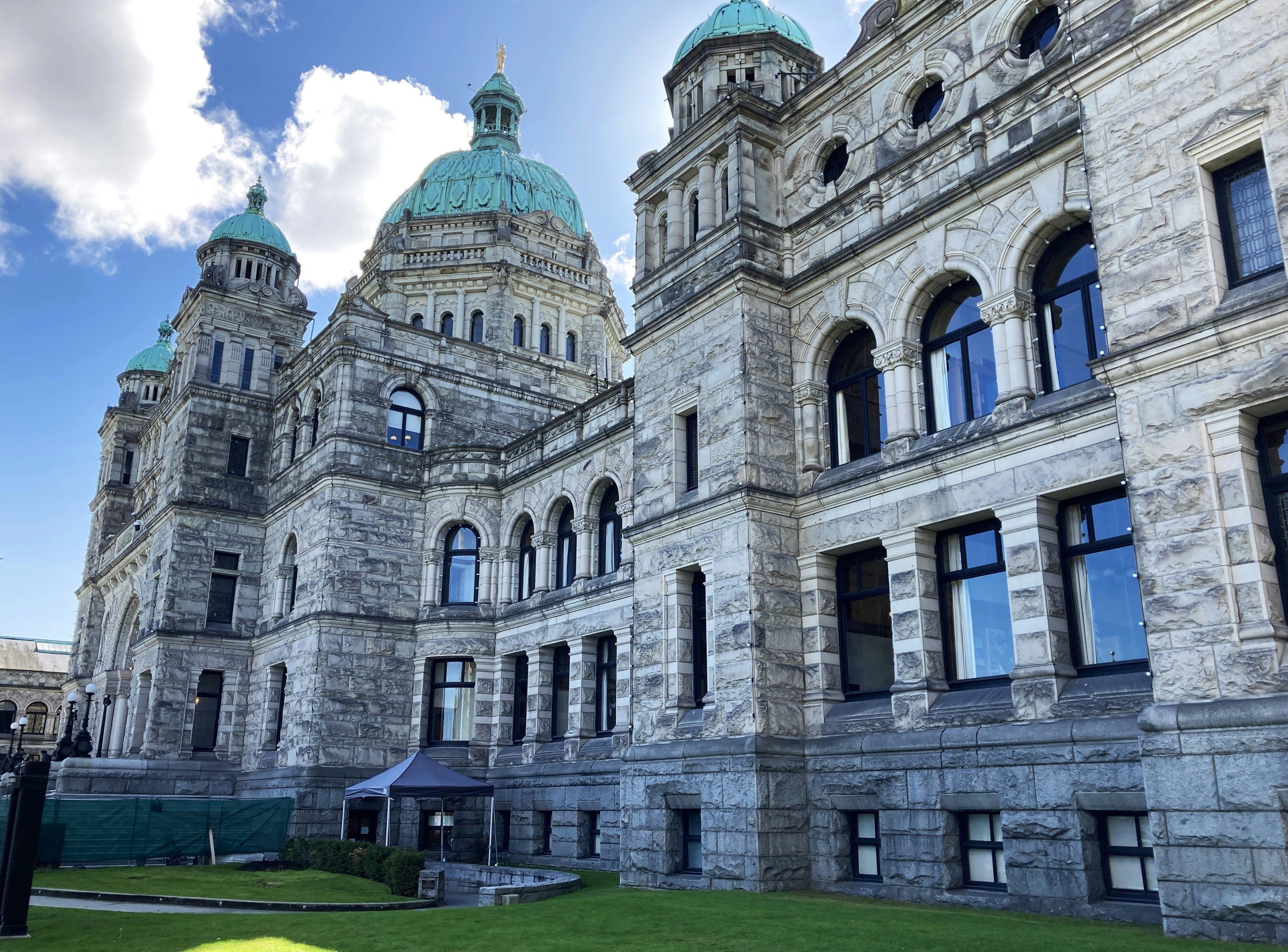
No province has a larger unresolved treaty gap. Most of BC was never formally ceded. The land question is not a historical abstraction here, it is a live legal and political reality that DRIPA attempted to address through aspirational language and produced instead a crisis of legal uncertainty that is still unresolved. The crisis is real. The political window it has opened is also real, and it will not stay open indefinitely.
BC also has something that makes the structural change being proposed considerably more achievable than it would be at the federal level. A unicameral legislature. One chamber. No Senate to navigate, no second house to bring along, no constitutional amendment required to add dedicated seats proportional to Indigenous population. The BC Legislative Assembly can do this on its own authority. The mechanism is simpler here than at the federal level.
This matters because the usual objection to serious structural proposals is complexity. Too many moving parts. Too many approvals required. Too many opportunities for the political class to run out the clock while appearing to engage seriously. That objection does not apply here. BC can move. BC has every reason to move. And if BC moves, it does something that has never been done in this country’s history: it demonstrates that a Westminster parliamentary system in Canada can make genuine room for Indigenous representation inside its institutions rather than managing Indigenous peoples permanently outside them.
That is not a small thing. That is a model for every other province and ultimately for the federal parliament watching from Ottawa. British Columbia, the province with the largest unresolved treaty gap and the most acute Indigenous representation crisis, becomes the province that solved it first. That is something to carry with genuine pride for the rest of our existence as a political community. Not performative pride. The kind that comes from having actually done something hard and done it right.
Now look at who is supposed to be solving this in 2026.
The BC Conservative leadership candidates have all called for repeal of DRIPA. Every single one. Repeal is not a policy. It is a bumper sticker. It tells the anxious settler base what it wants to hear without offering Indigenous communities or non-Indigenous communities anything structurally different from what existed before DRIPA, which was already failing by every measurable indicator before the ink dried on the legislation. Repeal returns British Columbia to the condition that made DRIPA politically possible in the first place. It solves nothing. It names nothing. It offers nothing. It is the sound a political party makes when it has decided the base matters more than the problem.
The BCNDP is worse, because they actually had the courage of their stated convictions once and then ran from it as fast as their legs would carry them.
In 2018 David Eby, then Attorney General, released a report on electoral reform that included a specific recommendation: that a legislative committee be appointed to examine creating dedicated Indigenous seats in the BC Legislative Assembly. His recommendation. On government letterhead. The committee was never appointed. The seats were never examined. Eby moved on to other files and the recommendation was quietly filed with every other serious idea the progressive political class has produced and then abandoned the moment it required something beyond a press release.
Eby became Premier in 2022. He passed DRIPA and called it a new day for reconciliation. When the courts began taking DRIPA seriously, when the legal uncertainty it generated started threatening his one-seat majority, he moved to suspend the very legislation he had championed. An Indigenous MLA in his own caucus said she could not support it. He backed down. He called the episode the most challenging issue he had worked on in government.
The most challenging issue. For him.
The man who once recommended Indigenous seats in the legislature, who passed DRIPA in celebration, who tried to suspend Indigenous rights legislation in a confidence vote, found the experience challenging. The communities that have been waiting for clean water since before Eby entered politics are presumably finding their own experience challenging as well, though nobody in the legislature has been asked to speak to that directly because they have no guaranteed seat from which to do it.
This is what progressive reconciliation looks like when the rubber meets the road. It looks like a unanimous vote and a celebratory press release followed by a quiet suspension motion when the costs arrive. It looks like a recommendation for Indigenous seats that never becomes a committee. It looks like fifty-six years of frameworks, strategies, calls to action, and aspirational legislation that have collectively produced a life expectancy gap of fifteen years and a homelessness ratio of seven to one.
The progressive political class did not fail Indigenous peoples despite their commitment to reconciliation. The commitment was always to the performance of reconciliation, which is a different thing entirely. Performance generates goodwill, votes, grant applications, and academic careers. Performance does not generate clean water or guaranteed seats at the table where the decisions are made. When performance became structurally expensive, Eby reached for the suspension motion. When the performance became politically inconvenient, every Conservative candidate reached for repeal. Both moves reveal the same truth: neither party was ever willing to do the one thing that would make the performance unnecessary.
Neither party has looked at the Songhees and Esquimalt Nations sitting eleven minutes from the legislature, on territory that was here before the legislature, that will be here after every current politician has been forgotten, and asked why the people most affected by the decisions made in that building have no guaranteed seat inside it.
A child born in a BC Indigenous community the year the White Paper was rejected is in their mid-fifties now. They have lived their entire adult life inside fifty-six years of managed failure that followed the rejection of one inadequate offer with nothing adequate in its place. They are not waiting for another conference. They are not waiting for another framework. They are waiting for someone to make the actual offer.
The Waitangi Tribunal in New Zealand was built to settle historical grievances with finality, converting historical relationship into present political and economic reality through enforceable decisions. The Māori seats were built to guarantee that the people governing New Zealand included the people whose ancestors had governed it before anyone else. Together they constitute the offer Canada should have made in 1969 and still has not made.
The scars of what was done will not disappear with any policy. They are permanent. The goal is not erasure of history but a functional present and future built honestly on top of it. The Māori experience is not without ongoing tension, ongoing inequity, ongoing argument about whether the model has delivered enough. Those tensions are not evidence that the model fails. They are evidence that it works, because the Māori have the standing and the voice to have those arguments inside institutions that take them seriously. Bilateral dissatisfaction in a democracy means the system is making real tradeoffs rather than just performing them. When nobody is unhappy it means nothing consequential is happening.
Nothing consequential has been happening in BC for fifty-six years.
Make the offer. Build the tribunal. Expand the legislature. Let the nations decide who fills the seats and trust that the governance capacity to fill them has been there all along, not created by settler generosity but freed from settler obstruction.
That is not assimilation. That is what the social contract looks like when it is finally extended honestly to everyone living inside it.
The offer was never made in 1969. The only question left is whether anyone has the courage to make it now.
Another thoughtful piece, and yes, seats in representative proportion to population seems an ethical offer, one I'd support. I expect some FN might focus on lost opportunities to extract rent through self-serving friction for, even outright destroying, nation building projects.
One request:
"It tells the anxious settler base what it wants to hear without offering Indigenous communities or non-Indigenous communities anything structurally different..."
I'm not sure who you mean by "settler base"... new immigrants? internal migrants? I'm not a settler, and reject the label outright. I was born in Canada, my chosen label is Canadian, and I'm the only one who labels me. Calling me, and the people I know, "settlers" or "colonials" ends the conversation. I will turn away because it's not appropriate or respectful.
While I haven't yet read the full article ... I'm really looking forward to it ... I'm wondering if the separation of "Indigenous" - which applies to all Canadians born on the land, in my opinion - is yet another aspect of "The British Great Game of Divide and Conquer"? Specifically, by legally recognizing a group based on "race," are you not creating a false dichotomy? I'm reminded of the Israel/Palestine conflict ... and, really, that kind of division is very evident everywhere colonialism or forced migration has taken place.
After sitting down and reading more closely, I'm sure I'll have other questions and possible connections or ideas!