



Author’s Note: Today we are introducing something new to The Municipal Fly. Alongside our weekly newsletter you will occasionally find a piece filed simply under Essays — longer, more personal writing that follows no fixed schedule and arrives when an idea demands it rather than when the calendar requires it.
These essays are written in the first person and reflect my own thinking on issues as they arise — topical, sometimes unresolved, always honest. They are polished in presentation but deliberately unfinished in thought. That is the point. Michel de Montaigne, who more or less invented the essay as a form in the sixteenth century, called his pieces “attempts” — a trying-out of an idea rather than a declaration of one. That is what these are. I am not arriving at conclusions so much as thinking out loud in public, and inviting you to follow the process. I hope you find them worth your time.
I have been thinking about W.A.C. Bennett lately. Not the monument, not the dam that bears his name, but the man before all of that — the hardware store owner from Kelowna who left school after Grade 9 and had, by any reasonable measure, no business being Premier of anything. He built BC Hydro. He built BC Ferries. He declared the province debt-free. Seven consecutive elections. Twenty years. When I wrote about him recently I ended with this: Not grievance. Not culture war. Not a list of things to be against. A vision. A province to build. The audacity to believe you can.
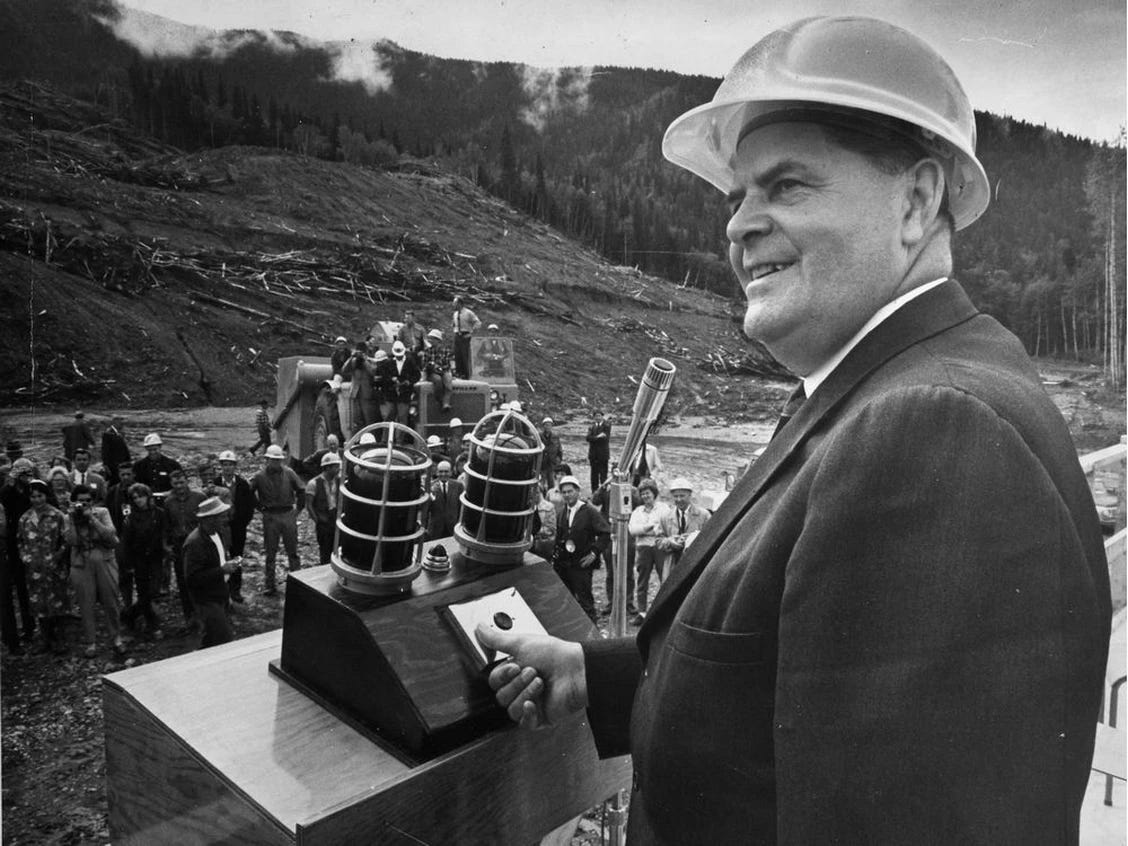
I meant it as inspiration. I am less sure now that anyone is listening.
I have been a conservative for my entire adult life, though not always a card-carrying member of any particular Conservative party. I am not a conservative because of my position on vaccine mandates or trans-rights but because my natural inclination toward a solution to a problem is to look to what exists and what has been done before for insight and guidance. This is, I think, an important distinction — one that the current moment in British Columbia politics seems determined to erase. There was a time, not so long ago, when the federal Liberal Party was a perfectly comfortable home for people of conservative instinct. Paul Martin was there. John Turner was there. In this province, the BC Liberals housed the conservative vote for a generation; many federal Conservative MPs during Stephen Harper’s years were active BC Liberals as a matter of simple political geography, the two tents sharing more than they cared to admit. Conservatism, properly understood, has always been a broad tradition. It has had to be. Canada is a broad country.
Someone should tell Anthony Russo.
Russo is a Kelowna man — Bennett’s Kelowna, the same Okanagan light — who has appointed himself the conscience of the Conservative Party of British Columbia. He runs a media presence called Glorious & Free, through which he dispenses judgements about who is and is not a true conservative with the serene confidence of a man who has been granted this authority by someone. He has approximately three hundred followers on Twitter. He holds no elected office. He has no official role in the party whose soul he has taken it upon himself to save. None of this troubles him.
I should say here that I am not in a position to mock a man for his follower count. I have examined my own numbers and they do not embarrass him. But I am not, to my knowledge, publicly demanding the disqualification of candidates from major provincial leadership races. This is the distinction I would like to examine.
Russo’s current target is Caroline Elliott, one of five candidates in the race to lead BC’s official opposition, a race that will be decided on May 30th. I will be clear: I am not writing this as a defence of Elliott’s candidacy. I do not think she is the strongest candidate available to the party at this moment, and that is a view I am entitled to hold. What I am not entitled to do — what none of us are entitled to do — is demand that she be removed from the ballot before 42,000 party members have had the chance to make up their own minds. That is their right. It is, in fact, the entire point.
Russo disagrees. His grounds are these: during the pandemic, Elliott gave media interviews in which she questioned why, if British Columbia was mandating vaccines for public sector workers, teachers had been exempted. She was not calling for teachers to be vaccinated. She was pointing at what appeared to be an inconsistency in existing policy and asking about it out loud. This is, one might argue, a fairly conservative instinct — scrutinizing government decisions, demanding they be applied evenly, questioning the logic of the people in charge. One might argue that. Russo does not.
In Russo’s reading, asking the question is the same as supporting the mandate. Proximity to the idea is contamination. Elliott has since said clearly that she opposes mandates. Russo posted to Twitter this week — beneath a neon sign reading “Glorious & Free,” with the gravity of a man delivering a verdict — the following: You don’t go from pushing Mandates on Kids to leading conservatives without answering for it. What matters is what it says about judgment and values. Should this disqualify her?
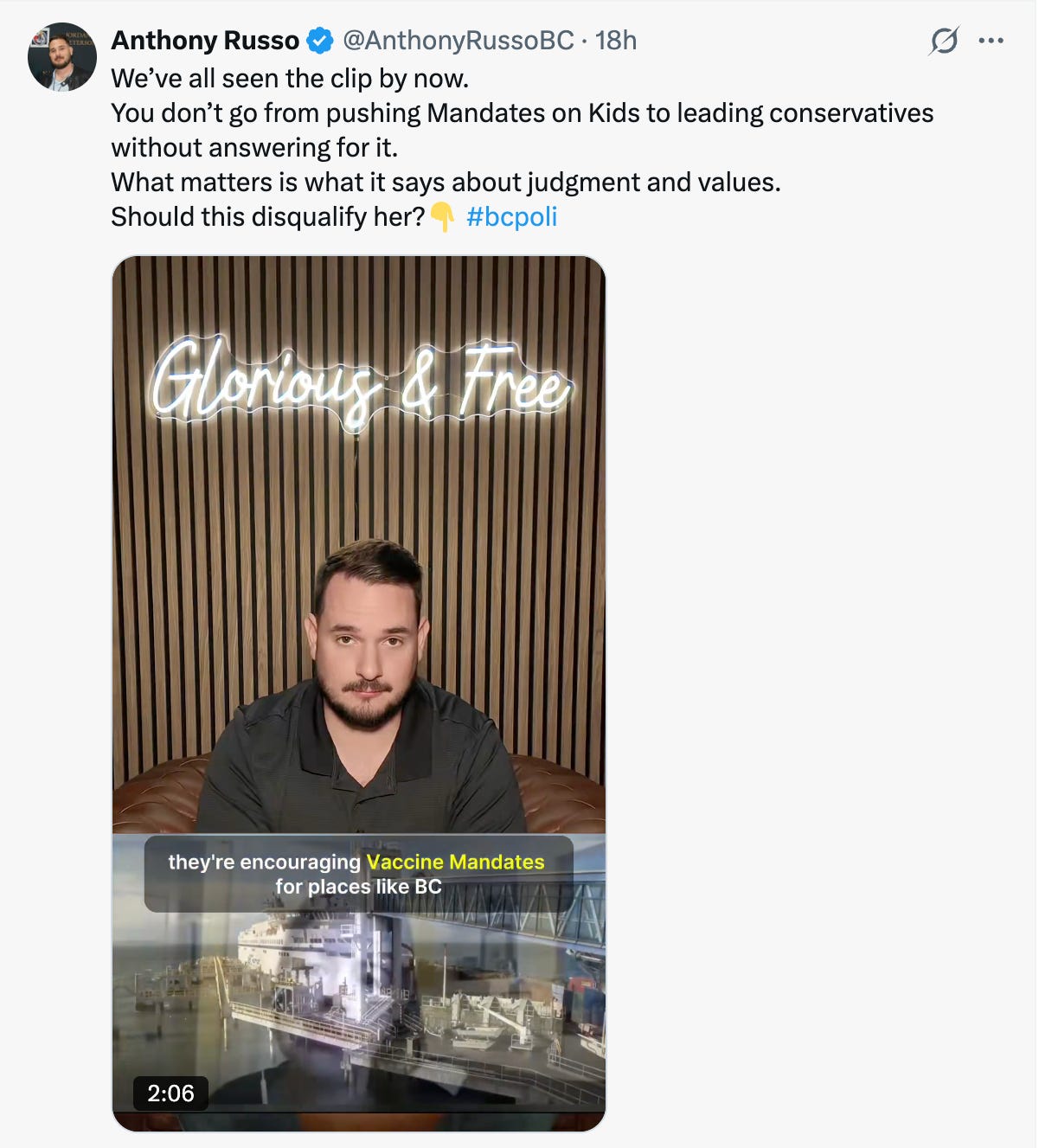
She was not pushing mandates on kids. She was asking why one group of workers was treated differently from another. But that distinction no longer matters. The recantation comes too late and means too little because the test was never really about policy. It was about where you stood in the great tribal sorting of 2020 and 2021, which side of the line you were on when the line was being drawn. Elliott, in his judgement, was on the wrong side. You do not get to cross over. The gates are closed and Russo holds the keys.
This is worth being precise about, because it is the structure of purity politics and it is genuinely corrosive. It is not simply that the standard is high. Political movements are entitled to standards. It is that the standard is retrospective, immovable, and administered by people who were not elected to administer anything. If the members choose Elliott, Russo will not conclude that he was wrong about her. He will conclude that the members were wrong about everything. This is what it looks like when someone removes choice from the people they claim to serve, while insisting they are doing it for those people’s own good.
Russo frames all of this through his Christian faith, which he links explicitly and deliberately to his politics. He speaks of truth-telling as a moral duty, of the party’s corruption as a kind of spiritual failing requiring intervention. I want to be careful here, because faith in public life is not inherently a problem and I have no interest in making it one. But when a man himself draws the line between his religion and his politics, he invites scrutiny of where that line leads. And what I see, looking at Russo’s trajectory, is something that has a name in the tradition he claims: convert’s fire. He came to his convictions through genuine struggle — addiction, recovery, a whistleblowing episode at a Kelowna charity that cost him his job and gave him, briefly, a public identity. He found faith. He found purpose. And then he found, as zealots sometimes do, that the world beyond his conversion was full of people who needed to be corrected.
The whistleblowing was real and it was right. Exposing alleged theft from a faith-based charity took courage. But there is a kind of person who, having once found fraud, begins to find it everywhere — who discovers that the spotlight tastes sweet and that the role of moral guardian, once assumed, is difficult to put down. The question is no longer whether someone stole from a safe. The question is whether Caroline Elliott asked the wrong question about teachers six years ago during a pandemic that nobody fully understood as it was unfolding. The stakes have not risen. Only the appetite has.
Russo is not alone in this. He operates within an ecosystem of voices — some larger, some operating with rather more resources — that have made the policing of conservative authenticity into a full-time occupation. Wyatt Claypool, the Alberta-based co-founder of the National Telegraph who describes himself on social media as “Baptist. Zionist. Neoconservative,” and who was himself disqualified from a federal Conservative nomination by Pierre Poilievre’s own party, nonetheless has plenty to say about who qualifies as conservative enough in BC. Connor Gibson co-founded Common Sense BC with Aaron Gunn and helped engineer the takeover of the BC Conservative board in 2022 that set this whole current drama in motion. Tim Thielmann, now OneBC’s chief of staff, was fired from the BC Conservative caucus research office by John Rustad himself for promoting divisions within the party — then surfaced at OneBC, where promoting divisions appears to be the mission. And then there is Brittany Foote, a BC content creator who makes TikTok videos in pink and describes herself as a “conservative girl’s girl” with “traditional values” — the kind of fresh-faced digital presence a party trying to reach young voters might find appealing, and who has found her niche in this same ecosystem of ideological enforcement.
All of which brings me, uncomfortably, to Aaron Gunn — the man widely credited with catalyzing the modern BC Conservative surge and who is, in the telling of this particular story, both hero and cautionary tale. Gunn is now a federal MP. Before that he was, for a time, a BC Liberal. He sought the leadership of that party in 2021 and was disqualified — removed from the ballot because his views, the party said, were inconsistent with its commitments to diversity and reconciliation. He was furious. His supporters were furious. The principle of disqualifying a candidate for holding certain views was, in that moment, treated as an outrage against democratic norms.
I leave that irony where it sits, without embellishment.
Bennett, I think, would have found all of this baffling. Not because he was without conviction — he had plenty — but because his convictions produced things. Roads. Dams. Universities. Ferries crossing the strait on a Tuesday morning. His conservatism was a verb. It did things in the world. It could be judged by what it built.
What does this conservatism build? What I find, looking at the output of Russo and his fellow travellers, is a relentless subtraction. This candidate is not conservative enough. That position is disqualifying. This person has failed the test. The movement is being corrupted from within. The gates must be defended. It is conservatism as a process of elimination — which will eventually, if pursued with sufficient enthusiasm, eliminate everyone.
There is a certain irony in all of this that I cannot leave alone. The BC NDP has spent decades perfecting the progressive purity test — the careful auditing of language, the ritual denunciations, the long memory for ideological transgression. They are very good at it. It has not always served them well but it is at least their tradition, their particular pathology, the thing their movement does when it turns inward.
Conservatives used to be different. They used to be too busy building things.
If the BC Conservative Party is serious about forming government — about ending what is now years of NDP rule in this province — it might consider leaving the purity test to the people who invented it. They have enough competition without inventing more of their own.
Russo has never won anything. He has only decided who deserves to.
We both prefer a conservatism of pragmatic, good governance, precedent, evolution vs revolution... and obviously the separation of church and state, but most of all, of getting things done.
People like your subject admire a weird construct, with little or no connection to reality outside evangelical "god-wants-you-to-be-rich" mega-churchs. Yet, no sane Canadian wants the developing 2nd world theocracy south of us. Fortunately their biggest obstacle to overcome is the reality presented every day in the news. Despite the money and effort applied by American actors, in Canada, in service of their jesus led, acceleration wet dream, we see the cautionary tale.
And, anyone visiting any major U.S. city can do a quick tour of the poorest neighbourhoods and ask themselves... is this what we want? Is this progress? Civilization? The neighborhoods of East St. Louis, Watts, Anacortes... on and on...nothing like them exist in the first world outside the U.S. Children eating potato chips for breakfast in boarded up shells of masonry with no utilities. These neighbourhoods conjure the black and white images of WWII carpet bombing, and capture the tradeoffs between our two countries very well.
unrelated... this time, the only vote I'll cast is for amalgamation, for the 3rd time, as they seem to wait for the answer they want. (75% for amalgamation in the 1st one, 65% in the 2nd. No councillor or mayor has received a fraction of the numbers.) We do not have a functioning democracy in Victoria as long as the NDP/BCGEU maintain this artificially segregated tiny city as their sandbox. The innumerable folks at the door who told me it was a waste of time, a performance where we know the ending... have finally convinced me. We'll have another pathetic slate of small people who love their ideas more than the community, working for their own benefit first.