


The BC Conservative leadership race has produced something remarkable. Five candidates, months of campaigning, countless debates, town halls, donor dinners, and press releases — and every single one of them has arrived at the exact same answer to the most complex political and legal question facing this province.
Repeal DRIPA. Problem solved. Next question.
Iain Black wants it as Bill 1, day one. Kerry-Lynne Findlay pledged in Prince George that she will “get rid of DRIPA” because it is “an overriding, property-affecting, pan-provincial decision that will hurt us all.” Caroline Elliott wants to scrap it immediately along with all associated “land back” policies. Peter Milobar has it as a headline pillar with a tidy subheading about transparency and certainty. Yuri Fulmer lists it under “Protecting Your Rights” alongside opposing mandatory land acknowledgements, which at least tells you something about how seriously he has thought through the distinction between a symbolic irritant and a constitutional reality.
Five candidates. One crayon.
I want to be clear about what I am not arguing. I am not arguing that DRIPA is good law. It is not. DRIPA is a clumsy, untested, and structurally unsound piece of legislation that replaced a functioning constitutional framework with a non-binding UN declaration embedded into provincial law — something no other jurisdiction on earth has had the audacity or the recklessness to attempt. The NDP deserves every bit of criticism it receives for passing it.
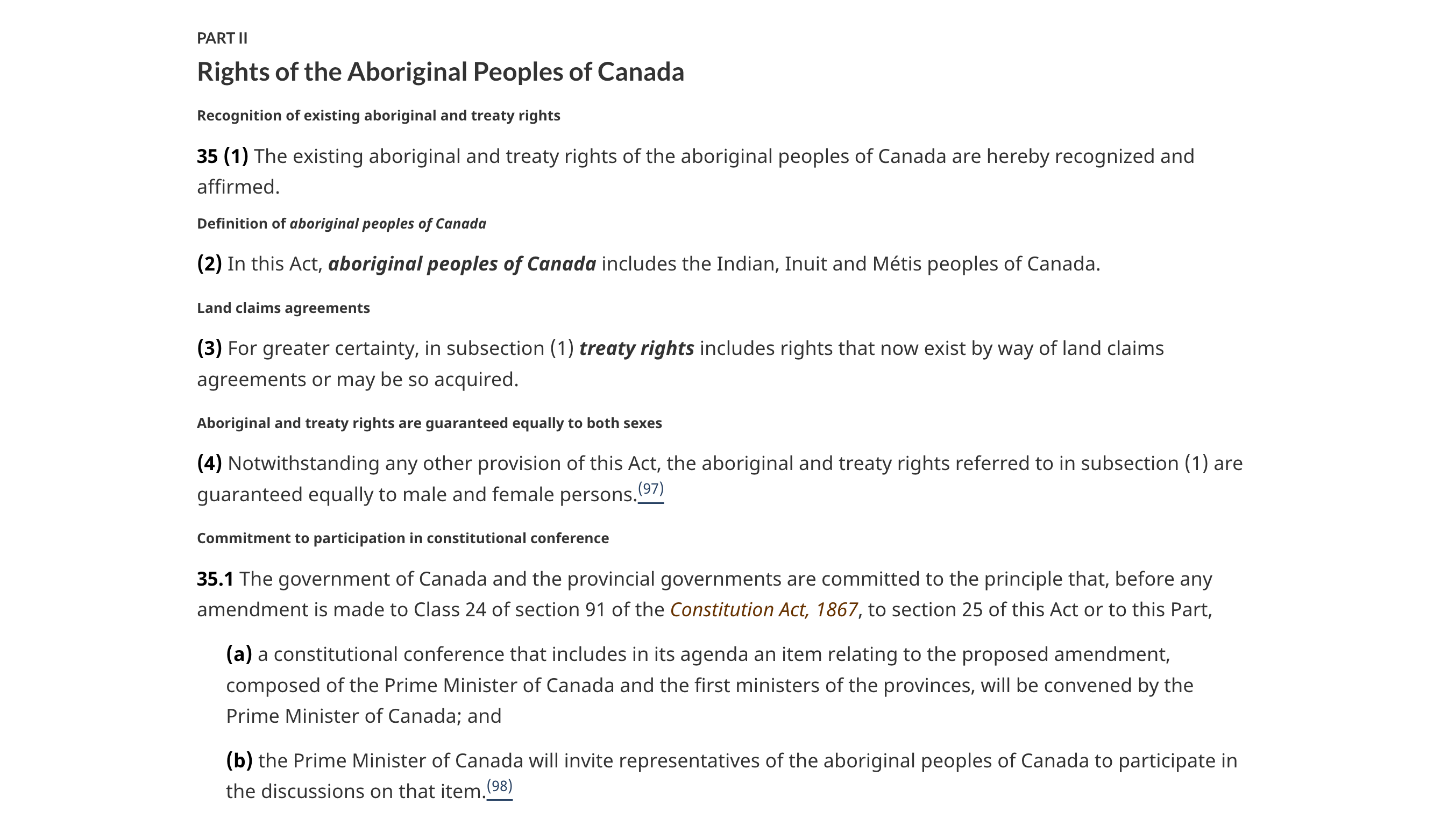
But here is what none of these five candidates will tell you, because apparently none of them have thought it through, or more likely because the people getting paid to run their campaigns have decided you do not need to know: repealing DRIPA does not repeal Section 35 of the Constitution Act, 1982.
Section 35 is not a piece of provincial legislation. It is not an NDP invention. It is not something any premier, Conservative or otherwise, can touch. It recognizes and affirms the existing Aboriginal and treaty rights of the Aboriginal peoples of Canada, and it was put there by the Crown — not by any government of the day, not by any parliament or legislature, but entrenched in the foundational law of this country. For those of us who believe that the Crown matters, that its obligations are real, that conservatism means something more than winning the next news cycle, this ought to land with some weight.
A true conservative looks at Section 35 and sees not a problem to be managed but a commitment to be honoured. The Crown made these commitments. We inherited them. That is how conservatism works — you do not pick and choose which inheritances to accept.
Repealing DRIPA does not close the courts either. The jurisprudence on Aboriginal rights and title in British Columbia did not begin with DRIPA and it will not end with its repeal. Decades of case law — Sparrow, Haida Nation, Tsilhqot’in — have built a body of legal reality that exists independently of any provincial legislation. Indigenous peoples in this province have the right to go to court. They have been going to court. They have been winning in court. A premier who repeals DRIPA and declares victory will find that reality waiting for them in the first injunction filed by the first nation whose title claim was not resolved by the repeal.
British Columbia is unique in this country and every serious person in provincial politics knows it. The vast majority of this land is unceded. There are no treaties establishing the relationship between Indigenous peoples and settlers across most of this province. That is not ideology. That is history. It is a fact that shapes every resource project, every land use decision, every infrastructure corridor, whether DRIPA exists or not. The candidates on that debate stage know this, or they should. If they do not know it, they have no business asking for the job.
And then there is the political reality, which you would think five people running for the leadership of a party that wants to form government might have considered. Indigenous peoples in British Columbia are not the disorganized, marginal political force some of these candidates appear to be imagining. Over the past several decades, First Nations in this province have built functioning, sophisticated political organizations. They have legal capacity. They have financial capacity. They have relationships with Ottawa. They have international standing under the very frameworks these candidates want to dismiss. You do not have to agree with every position taken by every Nation to acknowledge that they are a serious and durable political force, and that any government that treats them otherwise will find itself in a prolonged, expensive, and losing battle on multiple fronts simultaneously.
I am not talking about blockades. Illegal obstruction of public infrastructure is illegal and should be treated as such by the relevant authorities, full stop. I am talking about the legitimate, lawful, and frankly formidable political and legal capacity of Indigenous nations in this province. A government that walks in on day one and repeals DRIPA without a credible framework for what comes next is not governing. It is performing.
Which brings me to what is really going on here.
Someone has been reading polls. The polls say British Columbians are uneasy about DRIPA. They are uneasy about land rights uncertainty. They are uneasy about project delays and cancelled investments and the fog of legal confusion that has descended on this province since DRIPA passed. The polls are not wrong about the unease. The unease is real and legitimate.
But reading a poll and issuing a statement calibrated to that poll is not policy. It is what the federal Liberals do. It is the thing conservatives have spent several decades — rightly — mocking the Liberals for. Trudeau’s government did not have principles; it had focus groups. It did not have convictions; it had approval ratings. Every position it took was reverse-engineered from whatever the polling said the public wanted to hear that week. Real conservatives looked at that and called it what it was: spineless, unprincipled, and ultimately dangerous because a government without convictions cannot make hard decisions.
Now look at this race. Five candidates. Same poll. Same answer. Same crayon.
Peter Milobar had the most revealing moment of the entire campaign at the final debate when Findlay raised questions about whether he could be trusted to follow through on repeal. Milobar took it as an accusation about his Indigenous wife and erupted — “Just say it: my wife’s Indigenous so you think I’m in conflict of interest.” It was a genuine human moment and I do not doubt the emotion was real. But it also told you everything about the quality of the policy conversation happening in that race. The most substantive exchange about the most important issue on the platform was a borderline racist personal confrontation, not a debate about constitutional law or governance strategy. Nobody on that stage was equipped to have the harder conversation, because nobody on that stage had prepared for it.
Caroline Elliott at least had the honesty to question whether the others would actually follow through under political pressure. She is right to ask. When a government faces its first major confrontation with a Nation asserting title rights — and it will, on day one, regardless of what legislation is on the books — the repeal-and-hope strategy will encounter reality. What then? Elliott did not answer that question either, but at least she gestured at it.
Findlay, to her credit, said something in Prince George that was more honest than anything else said in this race: you do not necessarily have to replace legislation with legislation. She is right. The answer to bad law is not always more law. The answer is sometimes better governance — real partnerships, real economic relationships, real engagement with Nations as the capable and organized entities they actually are. That is a conservative insight. It is a shame she did not build her platform around it instead of putting the repeal front and centre like everyone else.
I have written in this space about what a genuine conservative answer to this question looks like. It involves the legislature, not just the courts. It involves representation, not just consultation. It looks at what New Zealand has built over 157 years of genuine partnership and asks what BC can learn. It takes the complexity seriously rather than flattening it into a pledge that fits on a lawn sign.
None of that is in this race.
What is in this race are five candidates who have handed the keys to outside political operatives, many of which do not live here, who will not govern here, and who will collect their fees and leave when the election is won or lost. These are professional campaigners whose job is to win, not to govern, and the difference matters enormously. Winning requires a simple message that moves votes. Governing requires a workable plan for a complicated province. The people crafting these platforms have optimized for the former and given no apparent thought to the latter.
The voters being courted by this particular plank are not the future of the BC Conservative Party. They are a constituency of fear and reaction, and while their votes count the same as anyone else’s, building a governing coalition around them is a trap. A party that wins on the promise of a simple answer to a complicated question will spend its entire term in office being held accountable for the gap between what it promised and what it can actually deliver. That is not a foundation for government. It is a foundation for one term and a decade in opposition.
BC deserves better than this race is offering. Conservative voters especially deserve better, because the party that is supposed to value existing institutions, constitutional obligations, and the hard wisdom of the past is instead offering them a bumper sticker.
Five candidates walked onto that stage in Vancouver on April 24th. All five agreed on the main issues. That is not unity. That is a failure of imagination wearing unity’s clothes.
Yes, there is fear and reaction, but no, the BC Conservatives are not responsible. David Eby and his version of the NDP are responsible. There is new racism, and David Eby and his NDP own that too. They made choices, crafted messages, that I and many, many people (well documented) predicted would create fear, division and reaction. They reap, and the community has been downgraded as a result.
FN represent 7.5% of the population of BC. Put another way, 92.5% of the population of BC is not FN. When one of the NDP's most religious called me a colonist, and I told them to go fuck themselves because I was born here and nobody labels me, but me, a senior FN leader said to that person, "We were conquered back when might was right, and now we're better. Get over it." 92.5% of the voters are NOT FN... think realpolitik. (No-one seems to want to hear that homo sapiens, and the others, have been migrating and "settling" all over the globe in continuous movement for ... I dunno... 200,000 years. Apparently this place is unique.)
On the subject of stupid land acknowledgements, what are they? A prayer? A performance? A signal of virtue? A wish? A legal statement? There doesn't seem to be an answer and under no circumstances will I speak one.
Here's what I DO know -I went to the courthouse a few months ago, requested and read 5 BC Supreme Court FN land claim cases and learned some surprising things:
First, there are many versions of history, who said what to whom, what was promised or not. It becomes clear in the reading that the parties do not agree on the facts.
Second, some parties (Esquimalt, Victoria) seem to take the view that they should not defend, but capitulate, when most defend.
Third, and most surprising, is that land acknowledgements, the official making them, the date and where, are cited in the documents as evidence the entity (the CRD, City of Victoria, the G.G. as real examples) want the case settled in favour of the FN plaintiff. SO... whatever we've been pretending about them... this is happening. Everyone who makes one in public should know this before they do it.