



I want to talk about the Conservative leadership race but I need to start somewhere else, because the leadership race doesn’t make sense until you understand the province it’s happening in.
British Columbia runs about five and a half million people through a full provincial apparatus: Premier, cabinet, ninety-three MLAs, the ministries, the agencies, the Crown corporations, the authorities. That's roughly the population of the Greater Toronto Area. Toronto, across all three levels of government, municipal, provincial and federal, is served by seventy-five elected representatives for 2.8 million people. One for every thirty-seven thousand residents. We have ninety-three MLAs alone and that's before you count a single city councillor, school board trustee, or regional district director.
I live in Victoria. I use it as an example because I know it, not because it’s unique. Greater Victoria has thirteen municipalities and four hundred thousand people. It has ninety-one elected mayors and councillors at the municipal level alone. One for every 3,813 residents. On top of that sits the Capital Regional District with its twenty-four directors. The CRD describes itself, on its own website, with what I can only read as pride, as being supported by more than seventy-five committees and commissions. Then the school boards. Then the provincial legislature. The Fraser Institute, not an organization given to left-wing complaint, looked at this arrangement a few years back and called it a cacophony. They were being generous.
The point isn’t Victoria. The point is that this is what British Columbia looks like everywhere. Layer on layer of elected representation, regional districts and municipal councils and provincial ministries all touching the same problems, all able to point at each other when nothing gets solved, and none of them clearly responsible for anything. Each layer with its own budget to protect, its own jurisdiction to defend, its own institutional reason to exist and to keep existing regardless of whether it is solving anything. We have built an enormous amount of government to produce a fairly modest amount of governing.
And underneath all of it, threading through every ministry and agency and authority, is a public service with its own ideas about the pace and direction of change. I’ll just say what I’ve noticed. Ferry fares keep climbing. Tax bills keep growing. Services keep getting harder to access outside the Lower Mainland. And every contract cycle the public service union negotiates more: more pay, more protections, more reasons why this particular reform needs a working group and that particular change needs further consultation. I’m not sure what to make of the fact that the one part of this apparatus that never seems to absorb any of the pain is the part that runs it. I’ll leave that with you.
What I will say is that a bold Premier on day one faces not just a legislature but a civil service with contractual, political, and institutional reasons to wait them out. To process the bold idea through seventy-five committees until it resembles nothing. To consult until the mandate expires. The apparatus is not designed to solve problems. It is designed to continue.
A real conservative should find all of this intolerable. Not because government is bad but because expensive government that doesn’t perform is a specific kind of theft — it takes money from ordinary people and converts it into process, into committees, into the diffusion of accountability so complete that nobody can ever quite be held responsible for anything. When the property tax bill arrives in January, and it goes up again, nine percent this year, ten the year before, who do you call? The municipality blames the province for downloading costs. The province points to the federal government. The regional district sends you a pamphlet about composting. The union files a grievance. The bill is real. The accountability isn’t.
This is the province five people are currently competing to govern. And watching them do it, I find myself wondering whether any of them have genuinely reckoned with what governing it would actually require. Because there are two possibilities when a politician looks at this apparatus honestly. One is that they haven’t looked. The other is that they have looked, done the math, and quietly decided that promising to fix it is a promise they can’t keep. I’m not sure which is more troubling.
Take BC Ferries.
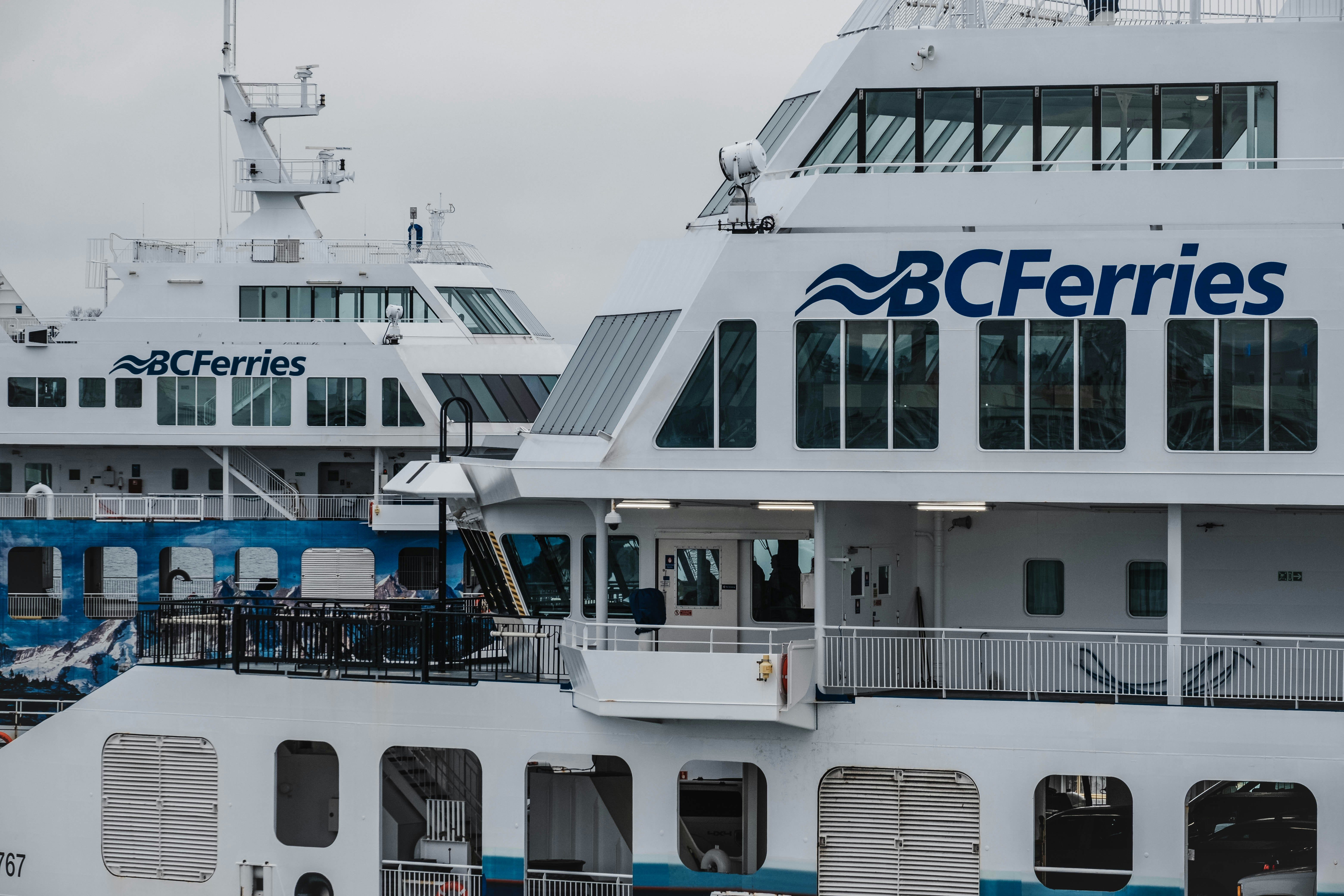
The ferry system is highway infrastructure for a quarter of the province. Vancouver Island, the Gulf Islands, the Sunshine Coast, the communities up and down the coast — hundreds of thousands of people whose economic lives, whose healthcare access, whose family connections depend on a boat showing up on time at a price a working person can afford. The system has been expensively, chronically mismanaged for the better part of two decades. Fares have climbed to the point where some Island residents factor the cost of a crossing into whether they can afford to see a specialist in Vancouver. Service on smaller routes has deteriorated to the point where communities are making real economic decisions around whether the ferry will actually run.
Not one of the five Conservative leadership candidates mentions BC Ferries. Not a word. Not a single commitment in any platform from any of them.
I don’t think that’s an accident. I think it tells you something about where these candidates’ mental map of British Columbia begins and ends. It begins somewhere around the Massey Tunnel and ends somewhere around the North Shore. The coast exists as scenery. The islands exist as real estate. Not as places where people are trying to build lives and need a government that has thought about them.
But I also think BC Ferries is exactly the kind of problem that disappears when you’ve absorbed the logic of the apparatus. Fixing BC Ferries would require confronting a Crown corporation with its own board, its own union contracts, its own institutional culture, its own deeply ingrained reasons why the fare is what it is and the service runs the way it runs. It would require a Premier willing to spend political capital on a fight that doesn’t generate culture war energy, doesn’t activate donors, and won’t resolve quickly enough to claim credit for before the next election. The apparatus is not designed to solve that problem. It is designed to manage it, to study it, to consult on it, and to present the next government with the same problem slightly more expensive than before.
The municipal burden works the same way. The property tax spiral isn’t a mystery. The province sets service requirements, retreats from funding them, and the municipality picks up the tab with the only tool it has. It has been happening for decades and it is hitting hardest outside Metro Vancouver, where tax bases are thin, populations are older, and there’s no density dividend to absorb the blow. A family in Campbell River or Prince George or Cranbrook opening a tax bill that went up ten percent is experiencing something real and structural, not a local accounting problem. One candidate, Iain Black, gets close to naming this. He noticed a Metro Vancouver wastewater plant that ballooned from seven hundred million dollars to three point eight billion and has something to say about regional district accountability. But he frames it as a Metro Vancouver problem. The problem is provincial. The downloading is a choice the province keeps making and keeps not owning. And every ministry that would have to give something back to fix it has a deputy minister, a union local, and a committee structure with a reason to explain why now is not quite the right time.
Then there is DRIPA.

Every candidate mentions DRIPA. All five. It is the signature issue of this race, the thing that activates the base, the thing every platform addresses with energy and apparent conviction. The NDP’s implementation of the UN Declaration on the Rights of Indigenous Peoples into provincial law gets more space in these platforms than BC Ferries, the municipal crisis, and transit investment combined.
And the answer from all five of them is repeal.
I want to be careful here because I have my own views on DRIPA and they are more complicated than repeal. But I’m setting that aside because the point I’m making is narrower. Repeal is a sentence. It is the first sentence of a policy, not the policy itself. What comes after? What is the model for resolving land questions that have been unresolved since before this province existed? What fills the space that DRIPA occupied, however badly it filled it?
None of the platforms say. And I think that’s because DRIPA has culture war energy and culture war energy raises money and fills rooms, and the hard work of saying what you would actually do about Indigenous governance in British Columbia does not. So they show up for the issue that activates the base and go quiet on the issues that require having actually thought about the province. DRIPA also, usefully for a candidate, is a repeal. A repeal doesn’t have to survive seventy-five committees. It doesn’t require the civil service to move. It requires one bill and a majority. The apparatus can’t protect what you’re dismantling. Which may explain, more than anything, why it’s the one issue where all five candidates found their voice.
I don’t know what to make of that, entirely. Some of these candidates are clearly capable people. Peter Milobar spent decades in municipal and regional government and presumably knows what a regional district actually does. Kerry-Lynne Findlay has federal experience. Iain Black has more detailed policy than the others, even if it tilts heavily toward Surrey. These are not frivolous candidacies.
But capable of what is the question a leadership race is supposed to answer. Capable of winning a culture war argument, clearly. Capable of performing conservative conviction on the issues that Conservative voters are already activated about, yes. Capable of walking into the Premier’s office on day one, looking at the apparatus — the ministries, the regional districts, the Crown corporations, the union contracts, the seventy-five committees patiently waiting to process the bold idea into nothing — and still finding the will to govern boldly?
That I’m less sure of. And I’m not sure they are either. Which might be why the platforms read the way they do.
The status quo in British Columbia is not serving British Columbians. It is serving itself. The committees exist to produce more committees. The ministries exist to protect their budgets. The union exists to negotiate the next contract. The regional districts exist to justify the regional districts. And the people paying for all of it, in taxes, in ferry fares, in the slow deterioration of services they were promised, are somewhere outside the frame entirely.
What I keep coming back to is that this is supposed to be the conservative party. True conservatism, the kind that takes institutions seriously, that believes the job of government is to get the fundamentals right before it reaches for anything grander, should be most enraged by this. Not performing outrage about land acknowledgements. Actually enraged by a province that has built this much apparatus and is still getting the fundamentals wrong. The ferry should work. The tax bill should be explainable. The infrastructure should exist before the density arrives. These are not radical propositions. They are the baseline of competent governance.
Five people want the job of fixing that. So far, from what they’ve written down, I’m not sure any of them have found the province yet. And I’m not sure the province, as currently constituted, would let them govern it if they had.
Glad you are back. Tired after hosting a two-day (very gratifying) charity event with a three month lead up, so just some brief thoughts:
- one size fits all governance fits nothing and no one, it can't. Historically, it was a practical consideration given available knowledge systems. Today, there's no excuse to pretend that we cannot get granular and devise outcomes that deliver results in context.
- outcomes (!) are sacrificed to compliance-based policy as an operational norm. Compliance is easier to manage, to "count" and present as an indicator of "progress." A focus on outcomes demands clarity, a dangerous thing. But such a focus means that with that clear vision ahead, well articulated, an outcome focus can tolerate innovation in delivering results that suit variable contexts (a.k.a. reality). A focus on outcomes, the results to be achieved, requires indicators that are very different from compliance and “busy-ness” indicators.
- management: everything requires effective, insightful, rigorous and continuously learning management that is accountable. Not in the "you're fired" sense (though, often enough). More in the sense of "That's not working, what can be learned and applied to a better approach" sort of accountability. It's a different kind of careerism, one that relies on learning & effective action over obfuscation and groupthink.
- groupthink: in my own leadership and management training, this was something to spot, expose and eschew. Now, it is required for promotion, enforced by those who, as in Mao's Cultural Revolution, will punish those who cannot be re-programmed to join in groupthink.
- the deserving, the undeserving and the elevation of victimhood: this is the antithesis of coming together. This view of the world prohibits building a just and rewarding future for all. It relies on continuing cycles of injustice, inhibits accountability for failures that must be addressed and feeds industries that spend (and spend) on so-called "deserving" people by dividing them from the undeserving who are taxed as a sort of penance, laden with a sense that they must forever atone for not being "deserving" especially if committing the sin of "success" (as variably defined by the arbiters of deserving-ness).
Change will not come quickly because the status quo has been developing for decades and it is all firmly embedded in the systems that run our world. Today, we enable instead of help and pat ourselves on the back. We deny opportunity for building strength and resilience to avoid feelings that invite self reflection. We expand the definitions to incorporate such broad, ill-defined categories and even unrelated categories such that meaning is lost, and then watch as the convenience of fuzzy meaning is used for advantage and power.
• Duck, and cover.
The title is apt for the CRD. We suffer the most expensive governance and the worst results that can be found anywhere in Canada. Victoria suffers acutely because the NDP/BCGEU monster organizes to steal our elections.
(Today Check news reports that pets in BC have double the risk of the next lowest province of dying of an overdose.)
2 referenda, and counting, the 1st with 75% in favour of amalgamation, the 2nd 65%... an exquisite example of 0 accountability, a process engineered to serve the people who engineer the process, at the expense of literally everyone else. The ironies compound: not one of these people received a fraction of the votes for their uncountable offices, yet they ignore overwhelming supermajorities, they cannot form the word "amalgamation." Mayor Alto actually says in the media she's surprised by the committees' unanimous result. Is every one of them there for the accelerated pension and NDP pork?
"It is difficult to get a man to understand something when his salary depends upon his not understanding it." Upton Sinclair
Per your previous post, selfishness prevails, productivity fails, and we suffer, hoping for leadership to serve us... first.
p.s. I was an enthusiastic participant in the process of reconciliation until Mayors Helps and Alto and the BC NDP fucked it up beyond all recognition. When Cook and McDonald reappear, when assholes renounce calling people names ("settler", "colonist"), I can be coaxed back to the table. Today, trust is an issue, and I'm busy washing my hair.